Friendship Bench
Depression is a major cause of disability in Africa, and we’re nowhere close to having enough mental health professionals to meet the need.
The Idea
Lay Psychotherapy
Fellow

Dixon Chibanda
Current Leader

Esther Tumbare
Mulago Lead
s




Total Investment
1650000
Grants
0
Equity/SAFE
0
Debt/Convertible Debt
Funded Since
2018
Geography
Sector
Structure
The Mission
Improve mental health.
How It Works
Friendship Bench pioneered a model where respected lay people—often “grandmothers”—deliver cognitive behavioral therapy from a dedicated spot—the “bench.” They train the providers, identify community members at risk of depression, then train and supervise Community Health Workers (“grandmothers”) to deliver 1–6 sessions of adapted talk therapy.
The Dream
All Zimbabweans have easy access to quality mental healthcare delivered by government supported Community Health Workers.
Why We're In
We’re in to support a new CEO catch up on evidence at a promising moment for scale. Friendship Bench had a rigorous study in 2016 that showed a ~63% reduction in depressive symptoms after 5+ bench sessions. They leveraged that result to scale their approach via the public health system with CHWs. However, the approach that’s scaling anchors on 1-2 sessions and as the government becomes the doer, they need more rigorous evidence on the right dosage for sustained impact. This is a top priority for the new CEO—and Mulago—and they are running studies in 2026-27 to get answers.
Delivery
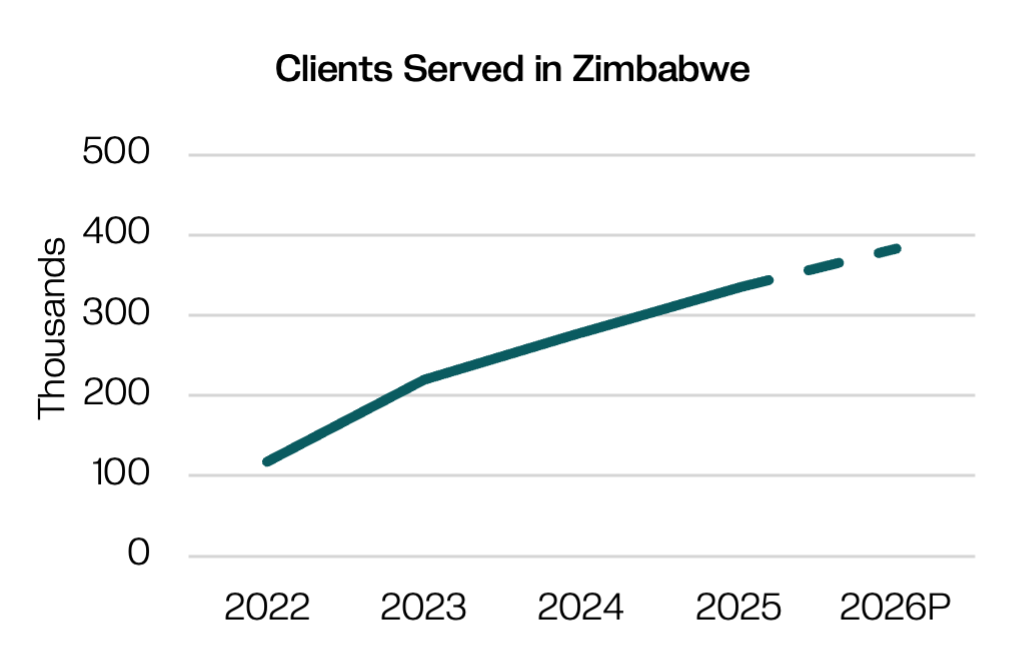
In 2025 Friendship Bench delivered mental health counseling to more than 330,000 clients in Zimbabwe.
The Model
A solution that works and can scale.
Efficient Recruitment
Identify people at risk of depression from community or health facilities
Adapted Therapy
Modified cognitive behavioral talk therapy delivered in 1-6 sessions on “the bench”
Lay Psychotherapists
Trained and supervised community members (“grandmothers”)
Strong referal network
People with more severe mental health issues are referred to trained clinic and hospital-based providers
Potential for Impact at Scale
Mulago uses four criteria to gauge potential for exponential impact. The model must be:
This is about impact and evidence. A 2016 RCT showed that more than 80% of people had reduced depression symptoms 6 months after the intervention and program data indicates this 80% reduction is sustained. However, more than 90% of clients only got 1-2 sessions on “the bench”, a 60-80% reduction in dosage from the RCT. This year, Friendship Bench will start another impact evaluation to re-investigate dosage and explore the number of sessions needed for consequential and sustained impact.
This is about scope. The ratio of psychologists to patients on the African continent is 1:1.5 million so 90% of people who need care never get it. For Friendship Bench to work, a paid community health workforce (the “Grandmas” or other lay-providers) needs to exist who can be upskilled to take on the less critical mental health cases, referring clients with more serious conditions to professional health workers trained in MHC. Zimbabwe has the right conditions for this to work and government is bought in, though more needs to be done to fully integrate the intervention into policies and budgets.
This is about whether governments can deliver the model. This year government will be testing direct delivery of the full model 3 provinces, with Friendship Bench providing technical assistance. It’s a perfect chance to test the model and see where refinement is needed to make it simple enough for government to deliver while maintaining high quality. It could also further institutionalize the Friendship Bench intervension within MoHCC structures. They’re also continuing to test Friendship Bench in a Box with partner organizations outside of Zimbabwe.
This is about what the model costs if delivered by government and whether government is willing and able to pay. The government has formally committed to integrating the Friendship Bench model into their structures with an intention to figure out a pathway to scale (including payment) in the next five years. With Friendship Bench delivering, it costs ~$13/client per year, which is much higher than the $0.13 USD per capita that government currently spends on health annually. As they work on estimating the cost for government to deliver, Friendship Bench is betting that efficiencies in integration with national health systems will drive costs down. But if the model can ever be cheap enough for government to pay is a big question.
.png)
Friendship Bench is in Growth Stage, testing the strategy to scale the model through government and creating a toolkit (Friendship Bench in a Box) to support introduction into other country contexts.
Our Take
Friendship Bench is in the early stages of scaling through government but needs to catch up on evidence of impact, given the changes to their model since the RCT. As they test if the number of sessions can be reduced, they’ll look to balance simplicity while maintaining high quality. Their pilot with government will also provide a chance to test if the model is simple enough for government to deliver and where integration with existing government systems might offer efficiencies and drive down cost. Friendship Bench, having been borne from a research project, has a culture of continuous learning and iteration, which inspires confidence that they’ll continue to test the intervension and introduce the necessary adjustments to further improve the solution.
Are you a serious funder and want to learn more?
This is just a snapshot of what we know about the organization. If you're an investor or funder that might send some serious dough their way, we're always delighted to share more. Reach out and we'll connect you with the right person on our team.
*this is not monitored for funding requests.
.JPG)




Ujamaa Community Resource Team (UCRT)
Lasting Land Rights for Pastoralists.