New Seed
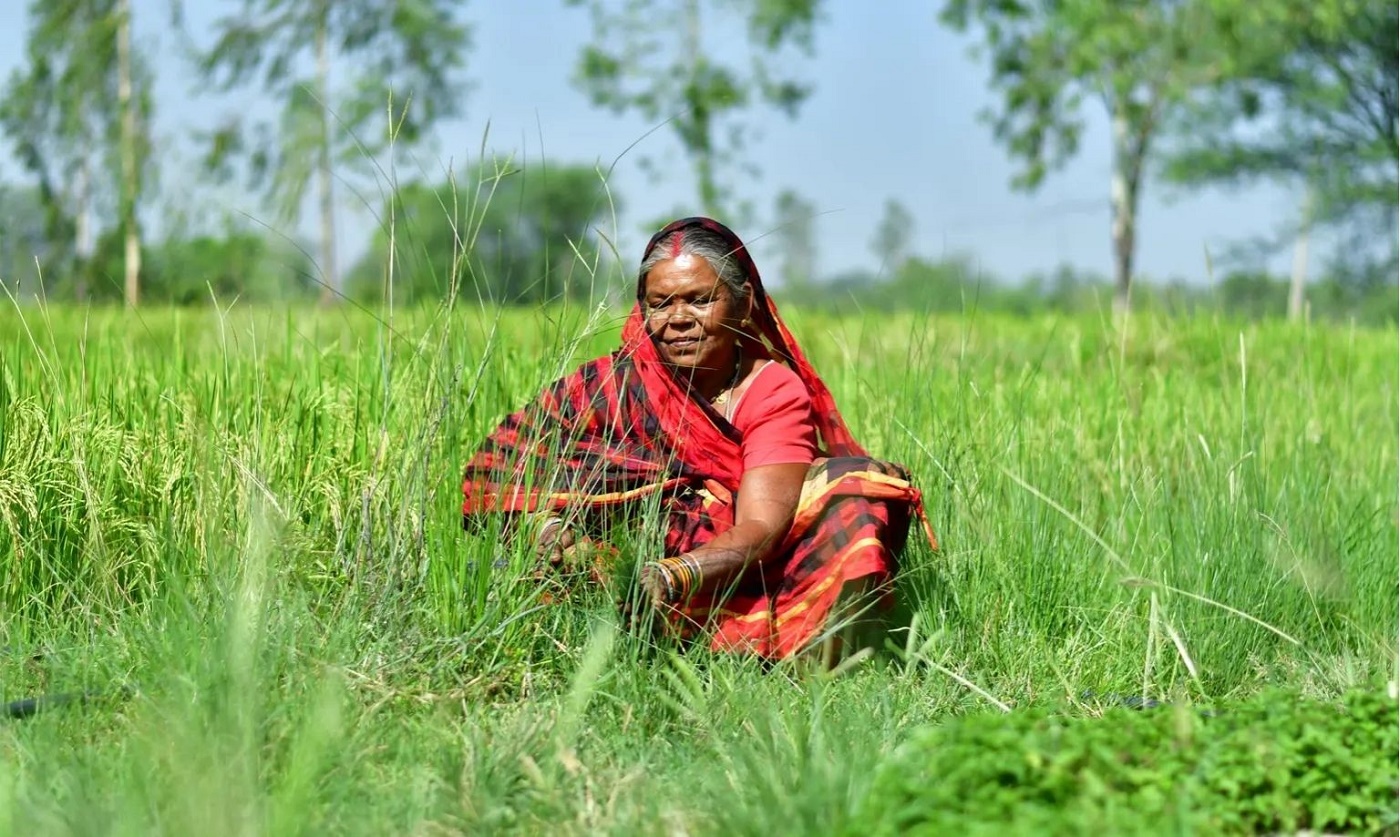
More than a billion people across the world get most of their nutrition from maize. It’s not very nutritious, especially if you're a growing kid without a diverse diet.
The Idea
Biofortified Maize
Fellow

Curt Bowen
Mulago Lead
s


Total Investment
2750000
Grants
0
Equity/SAFE
0
Debt/Convertible Debt
Funded Since
2017
Geography
Sector
Structure
The Mission
Well-nourished kids.
How It Works
New Seed breeds maize seeds that are rich in zinc, iron, and protein and—crucially—provide the big yields that drive farmers to purchase seeds in places where the norm is to replant. Seed companies have no incentive to develop or sell nutritious seeds, so New Seed uses donor money to breed nutritious and higher yielding seeds, then provides them for free to seed companies for mass production and distribution.
The Dream
Big seed companies market and sell nutritious seeds, saturating the market.
Why We're In
New Seed now has a track record of breeding better seeds that farmers actually buy. The jackpot is big international seed companies breeding and selling. Gene editing will one day make breeding cheaper and faster, but today this only works with a government subsidy. New Seed has great progress on that front (~$1M in subsidy to five companies). This is a bet that they can grow the subsidy and expand from Latin America to Africa by 2028.
The Model
A solution that works and can scale.
Make the best seeds nutritious
Seed companies already have access to high-yielding, climate resilient seeds (from global research orgs like CIMMYT). New Seed breeds these seeds to be nutritious over 4+ years and distributes them to seed companies. Gene-editing breakthroughs offer the promise to significantly accelerate this breeding process down to 1 year and make it easy for companies to do it themselves.
Produce seeds
Seed companies receive technical assistance and an initial philanthropic subsidy to produce biofortified seeds. In Guatemala, a government subsidy is beginning to replace philanthropy.
Sell seeds
Seed companies sell biofortified seeds directly to smallholders (or to NGO partners) without raising prices (currently ~$20/farmer with a $20 subsidy to seed companies in Guatemala).
Potential for Impact at Scale
Mulago uses four criteria to gauge potential for exponential impact. The model must be:
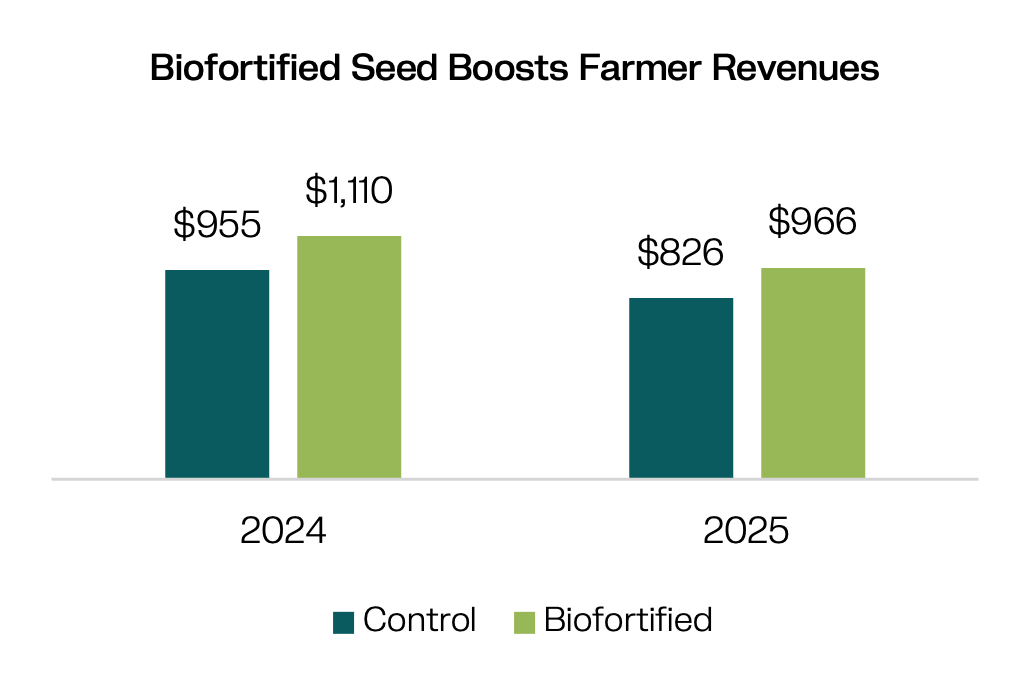
This is about impact and evidence. A 2023 Randomized Control Trial shows that moms and kids consuming biofortified maize have compelling improvements in Zinc status. Results from a follow-up absorption RCT (amount of iron/zinc absorbed is meaningful against stunting) are expected by Spring 2026. These studies build on literature showing nutrition impact from biofortified maize in other contexts. Internal analysis shows that their current seeds have >20% more zinc, iron, and lysine vs. market comparables, and provide ~$150 more in annual revenues (~16% gain) per farmer .
This is about scope. ~1B people depend on nutrition-poor maize, and stunting is a big problem in both Central America and SSA. This scales in places with farmers willing to pay for inputs, government subsidies (so far in Guatemala), and big seed distribution channels, initially via NGOs that sell to farmers (e.g., One Acre Fund) and eventually the biggest seedcos. CIMMYT (a global ag research org) is beginning to edit 100+ genes in African seeds and supplies a majority of hybrids to the African seedcos they hope to work with.
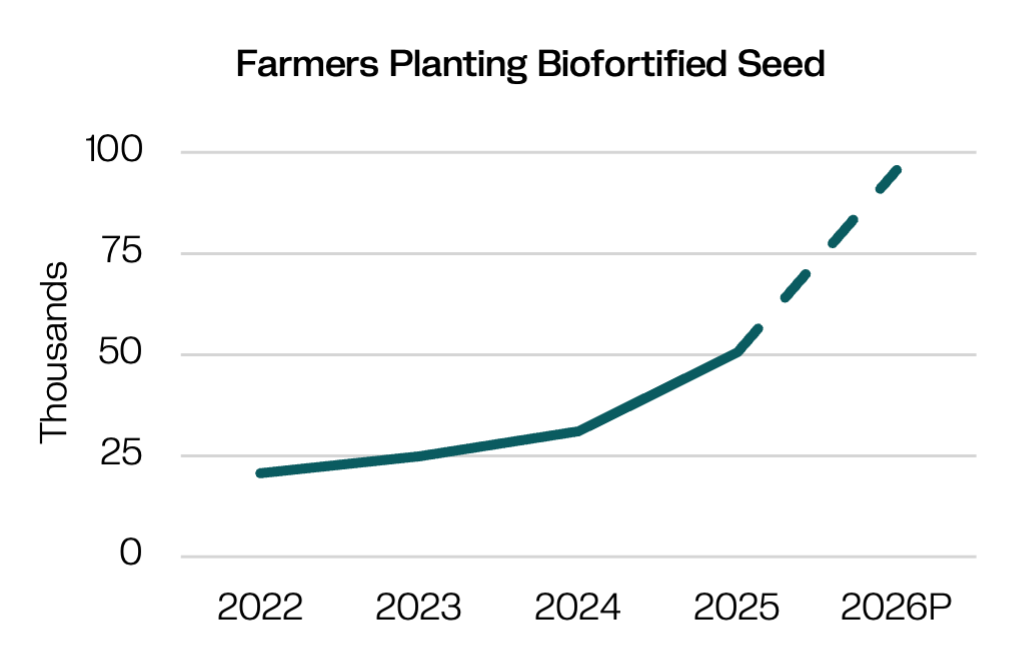
This is about whether businesses can deliver the model. 10 seed companies in Central America produced and sold hybrids to 50k farmers in 2025, up 60% from 2024. But operational issues in producing enough parental seeds for seed companies has slowed growth. One Acre Fund is currently testing seeds in Rwanda to save New Seed from doing the operational proof themselves. The CIMMYT partnership, while a win, doesn’t guarantee that it’ll be simple enough for African seedcos to adopt without mandates and subsidies.
This is about what the model costs if delivered by businesses and whether customers are willing and able to pay. Farmers pay ~$20 (competitive with market prices) and seed companies get a ~$20 subsidy/farmer. The annual subsidy of $1M in Guatemala is covered 70% by the government and the rest by philanthropy. Traditional breeding costs around $300k/hybrid (~4 years) but gene editing may dramatically lower costs and time of getting the best seeds to farmers.
.png)
New Seed is in mid-growth, nearing the Big Shift.
Our Take
While there have been bumps in the production of parental seeds, the demand is clear: seed companies are producing and farmers are buying, with a majority from a segment that don’t traditionally buy seeds . Their big win is renewal of the Guatemala subsidy, a strong signal that governments can create the conditions for a marketplace. The results of their rigorous absorption study are imminent as of Spring 2026, but the promise of gene editing and the Africa expansion are big unknowns. The CIMMYT and OAF partnerships are strong signals, though this is still a big bet on New Seed’s capacity to deliver on the dream.
Are you a serious funder and want to learn more?
This is just a snapshot of what we know about the organization. If you're an investor or funder that might send some serious dough their way, we're always delighted to share more. Reach out and we'll connect you with the right person on our team.
*this is not monitored for funding requests.
.JPG)