
OneReef
A third of the world’s coral reefs are in the Pacific and threatened by overfishing and climate change.
The Idea
Community-Managed Reefs
Fellow
Chris LaFranchi
Mulago Lead
s

Total Investment
1985000
Grants
0
Equity/SAFE
0
Debt/Convertible Debt
Funded Since
2009
Geography
Sector
Structure
The Mission
Vibrant reefs and thriving communities.
How It Works
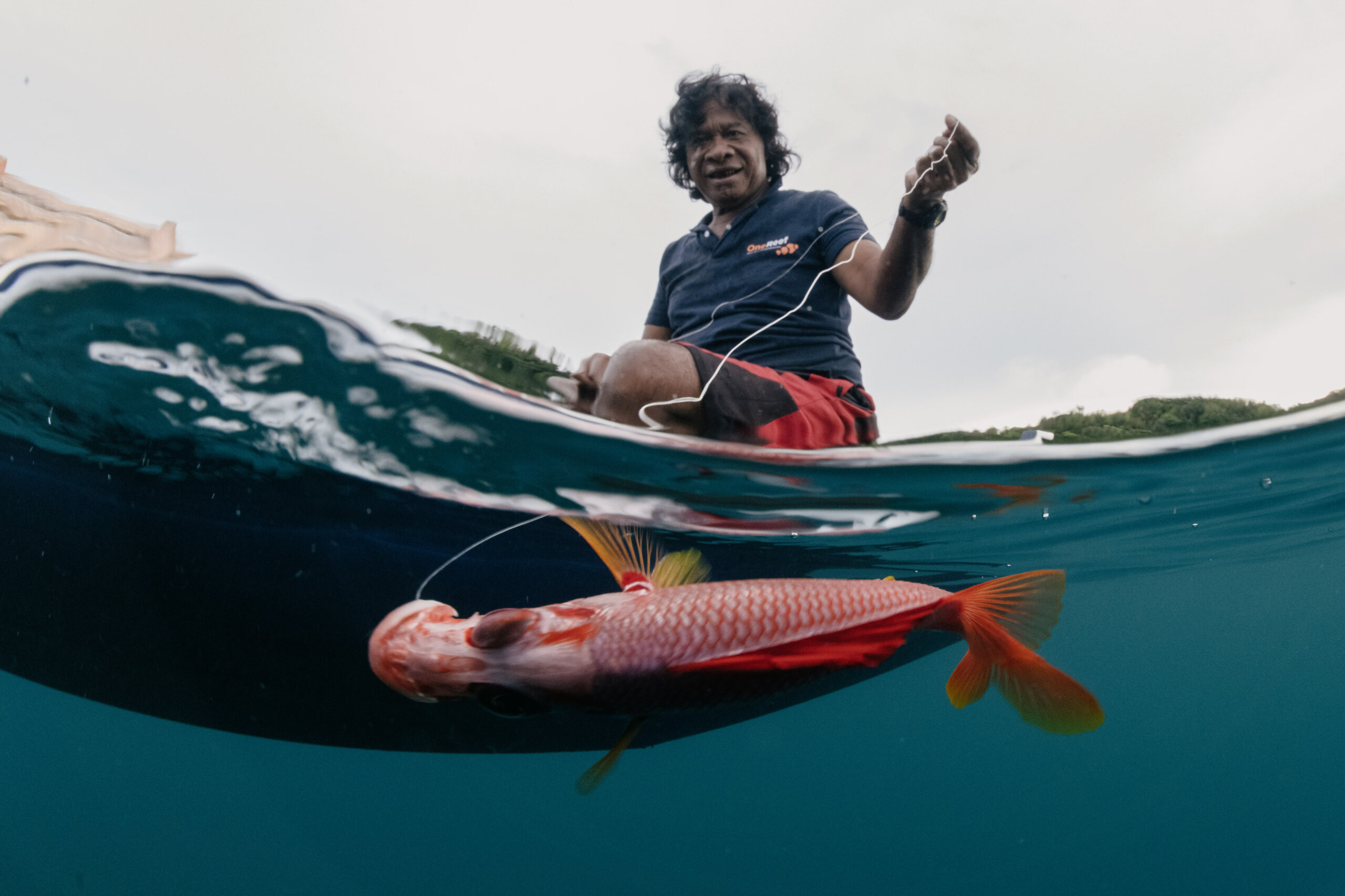
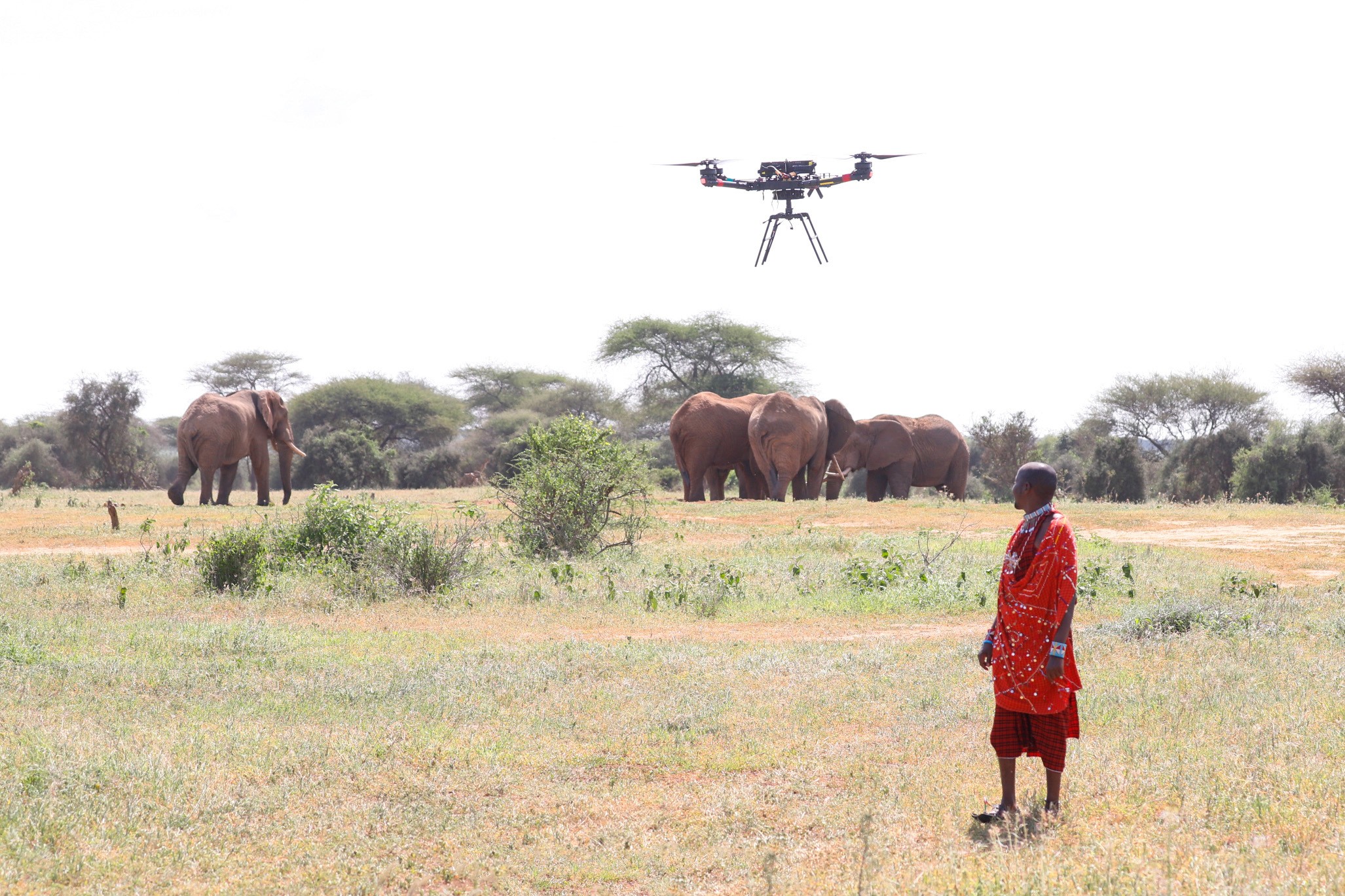
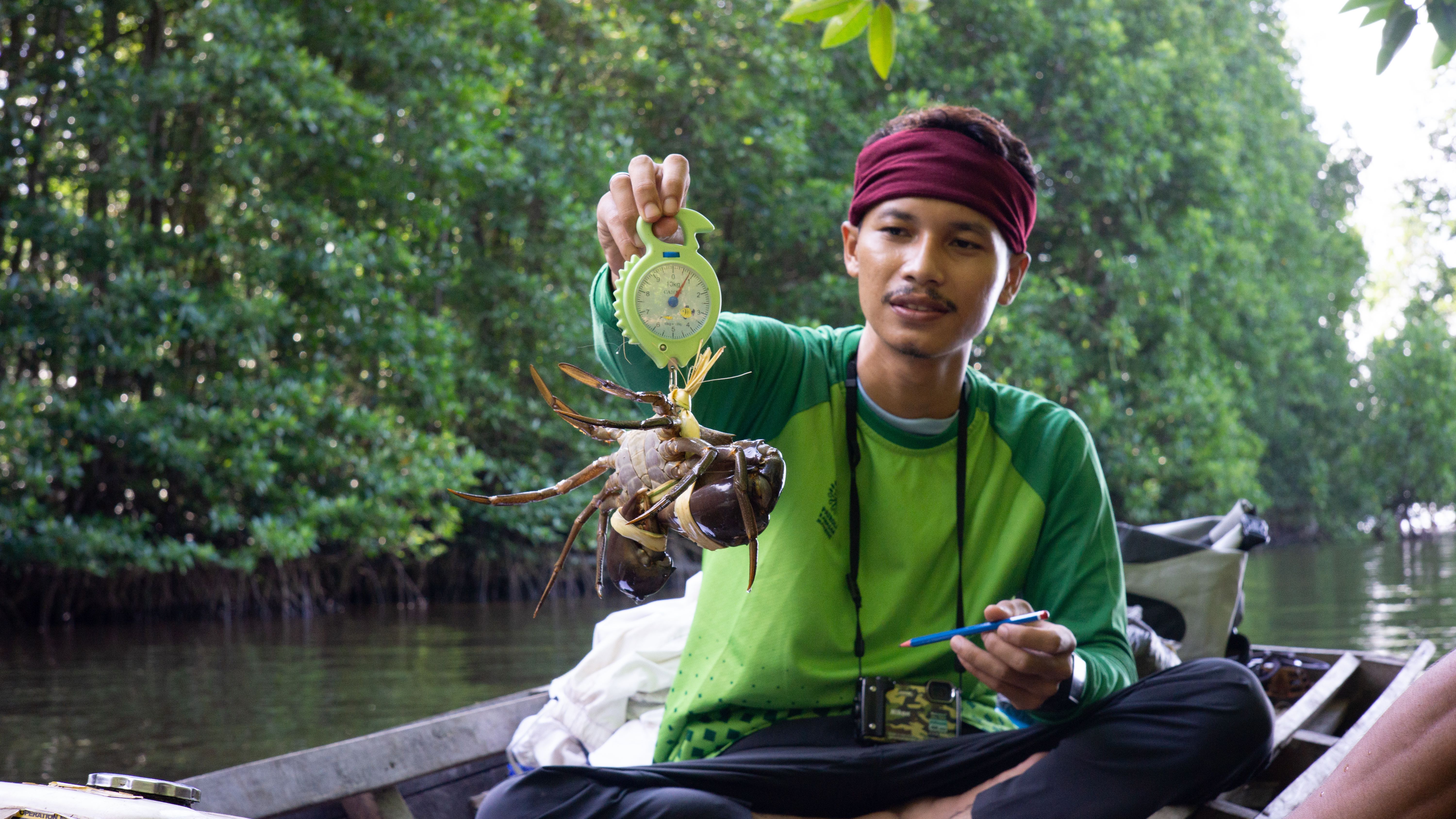
OneReef helps communities manage their reefs in a way that taps into traditional stewardship practices. They co-design management plans with communities that include no-take zones. They also bring in cutting-edge geospatial tools to monitor reef health and take a modern approach to enforcement, including community rangers and coordinated government response to incursions.
The Dream
Community-based organizations across Pacific Island Nations adopt and deliver OneReef's model, paid for by governments.
Why We're In
With a highly replicable model spanning the Pacific, OneReef already reaches 919K acres. In Koror, Palau—the most populous state, with high commercial and subsistence fishing pressures—the model increased food fish biomass by 90% to >1,000 kilograms per hectare, returning it to a healthy, thriving state akin to an unfished reef. They’re now scaling through the Oceania Collective, a network of Indigenous NGOs created by OneReef, who are replicating the model across 202K additional acres in Polynesia and Melanesia with a goal of reaching 1M additional acres.
Delivery
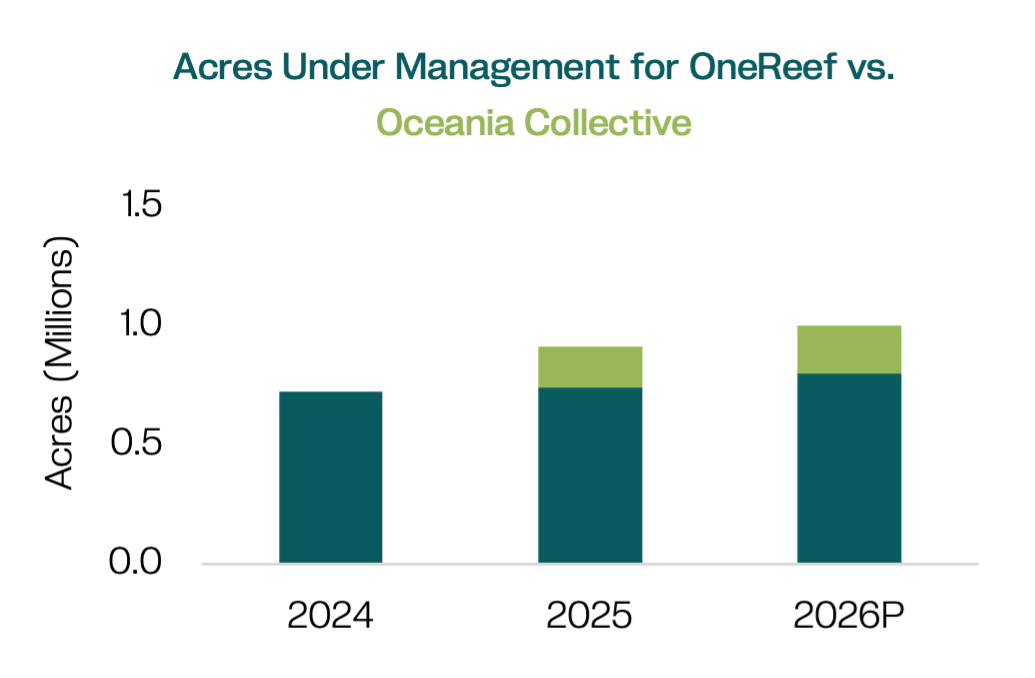
OneReef has grown direct delivery and is now focused on replication via the Oceania Collective. The goal in each expansion country is to have the NGO partner from the Collective spearhead efforts to build the evidence and demand government partnership and payment of the model.
Impact
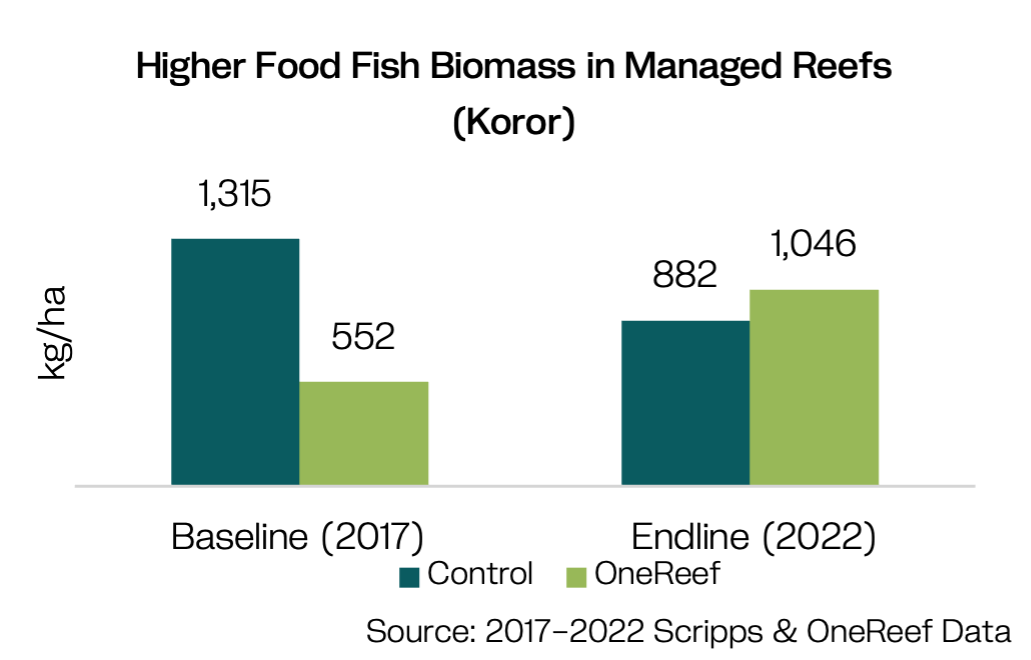
In Koror, Palau where there have been immense fishing pressures, OneReef managed sites show food fish biomass recovering to >1K kg/ha, the equivalent of a thriving, unfished reef.
The Model
A solution that works and can scale.
Spatial Management Plan
Co-designed with community, including best practices like no-take zones
Local Monitoring
Support community monitoring of impact
Enforcement
Support for community stewardship which may include government co-management
Livelihoods Support
Targeted investments in livelihood strategies that align with spatial management goals
Potential for Impact at Scale
Mulago uses four criteria to gauge potential for exponential impact. The model must be:
This is about impact and evidence. Since 2017, OneReef has worked with Scripps Institution of Oceanography to collect extensive data tracking reef recovery across Pacific sites using food fish biomass—a proxy for ecosystem health and human well-being. Overall, reefs are recovering, and community benefits grow with sustained protection. Across Palau and Pohnpei, biomass has risen the last 10 years, with multiple sites surpassing key thresholds (1,000+ kg/ha), including heavily fished Koror, where reefs now resemble unfished systems. Impact is strongest where pressure is high, but management is effective; in remote areas, success means maintaining high baselines. Early gains are driven by non-target species, with food fish recovery lagging but accelerating over time.
This is about scope. The Pacific Region supports approximately a third of the world’s remaining in-tact coral reefs. OneReef’s current involvement across seven countries covers over a million acres of healthy or recoverable coral reefs that could adapt to changing climate. For this to work, there needs to be local community-facing conservation organizations. Governments are already spending money on MPAs (which, if effectively managed, help ecosystems but often at the detriment of the people), so OneReef’s solution offers a compelling alternative. OneReef’s model could help hundreds of existing locally managed marine areas (LMMAs) achieve greater impact.
This is about whether government can deliver the model. OneReef has already replicated across multiple countries in Micronesia. They formed the Oceania Collective, which is a group of like-minded NGOs across the Pacific, to do the same across Melanesia and Polynesia. Early signals are good. Fiji's government adopted the LMMA model and works in close partnership with local NGOs — a real proof point that capable government partners could follow suit.
This is about what the model costs if the government pays. OneReef estimates it costs $1.52/acre/year to deliver the model. This is based on an in-depth analysis of what it currently costs OneReef to deliver across 59 communities (~804K acres) and what it would cost NGOs within the Oceania Collective to deliver this across an expanded portfolio of sites. In their analysis, OneReef prioritized 100 sites and grouped them into three tiers: Tier 1 (established LMMAs) at $50–75K/site, Tier 2 (emerging sites) at $100–150K/site, and Tier 3 (new or high-need sites) at $200K+/site. They estimate 40 Tier 1, 40 Tier 2, and 20 Tier 3 sites so that the portfolio of sites has an average cost of ~$100K/site for the first 3-5 years of support.
.png)
OneReef is in Growth stage, recruiting and training other NGOs to replicate the model and fine-tuning their understanding of impact and cost.
Our Take
Overall, we’re excited about the potential for community-managed reefs to go big. The impact story—while complex—is positive and strengthens the case for the LMMA model. That said, key questions remain on measurement. Reef recovery is slow, nonlinear, and highly context-dependent, with important indicators like food fish biomass lagging behind other early gains. Messy baselines and imperfect controls make it hard to isolate true impact from broader environmental and human factors. At the same time, OneReef has made real progress codifying its model and testing replication through NGO partners across the Pacific, including what it takes—and costs—to scale sustainably.
Are you a serious funder and want to learn more?
This is just a snapshot of what we know about the organization. If you're an investor or funder that might send some serious dough their way, we're always delighted to share more. Reach out and we'll connect you with the right person on our team.
*this is not monitored for funding requests.
.jpeg)