Rising Academies
Public schools across Africa aren’t equipped with the training, tools, and technology to provide the education that kids deserve.
The Idea
Supercharged Public Schools
Fellow

Paul Skidmore
Current Leader

Stephanie Dobrowolski
Mulago Lead
s



Total Investment
1450000
Grants
0
Equity/SAFE
500000
Debt/Convertible Debt
Funded Since
2019
Geography
Sector
Structure
The Mission
Get African kids to grade-level.
How It Works
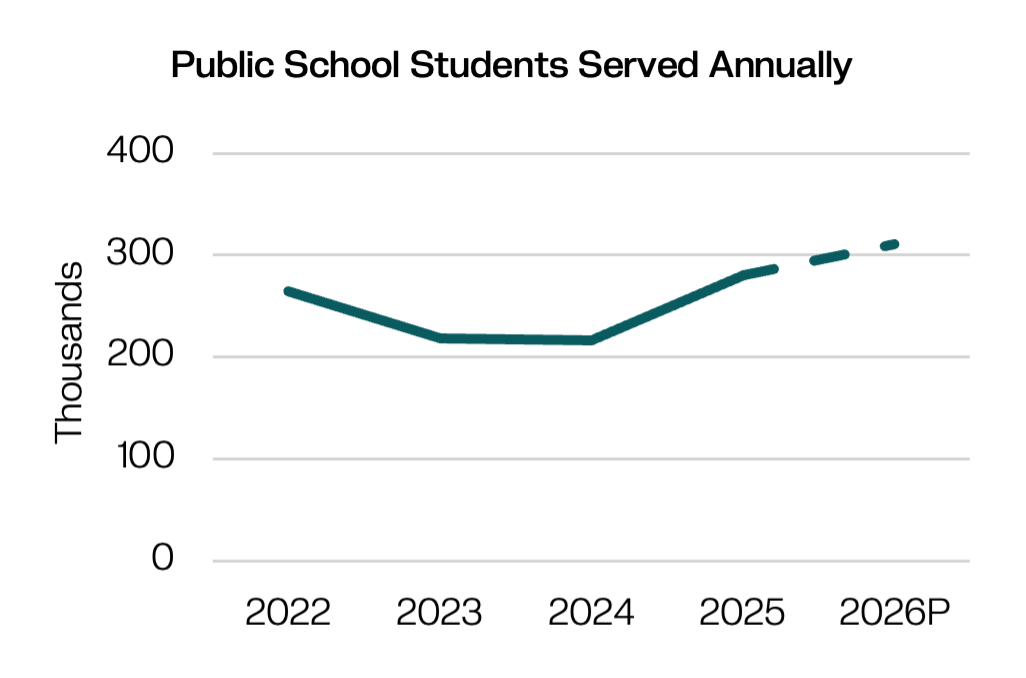
Rising partners with governments to supercharge public schools. Their structured, guided curriculum is coupled with regular coaching of teachers and administrators. Their data-heavy feedback systems drive continuous improvement within schools and systems, and they offer governments varied levels of engagement and control.
The Dream
Governments deliver high-quality education through private-public partnerships across Africa.
Why We're In
Rising is a rare bird: a for-profit with rigorous evidence of impact in public education. They achieved consistently excellent results in West Africa with an outsourced school management model. The Rwandan government is now paying for and scaling a much cheaper and equally effective version of the content, coaching, and technology bundle without Rising’s management. We’re betting that Rwanda lays the groundwork for a marketplace of affordable education solutions for African governments.
The Model
A solution that works and can scale.
Guided curriculum
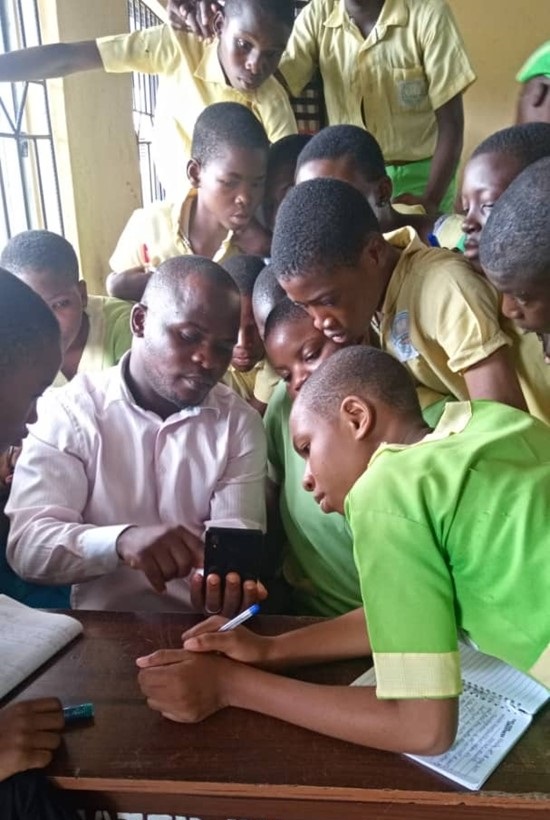
Rising and governments co-design clear, well-structured lesson guides and student learning materials that translate national standards into high quality, easy-to-teach content for every lesson.
On-site coaching
Rising co-delivers intensive upfront training of government teachers. Teachers then receive ongoing, individualized coaching and feedback supported by digital tools to improve content knowledge and turn pedagogical theory into daily classroom practice.
School management tools
Rising’s tech tools provide teachers, school leaders, and administrators with insights to identify priorities, target support, and drive continuous improvement. Rising’s integrated digital platform connects schools within the wider system for data-informed decision-making and accountability.
Beyond the classroom learning
Schools access AI-powered tools for personalized math learning (Rori) and teacher support (Tari) to accelerate mastery beyond the classroom.
Potential for Impact at Scale
Mulago uses four criteria to gauge potential for exponential impact. The model must be:
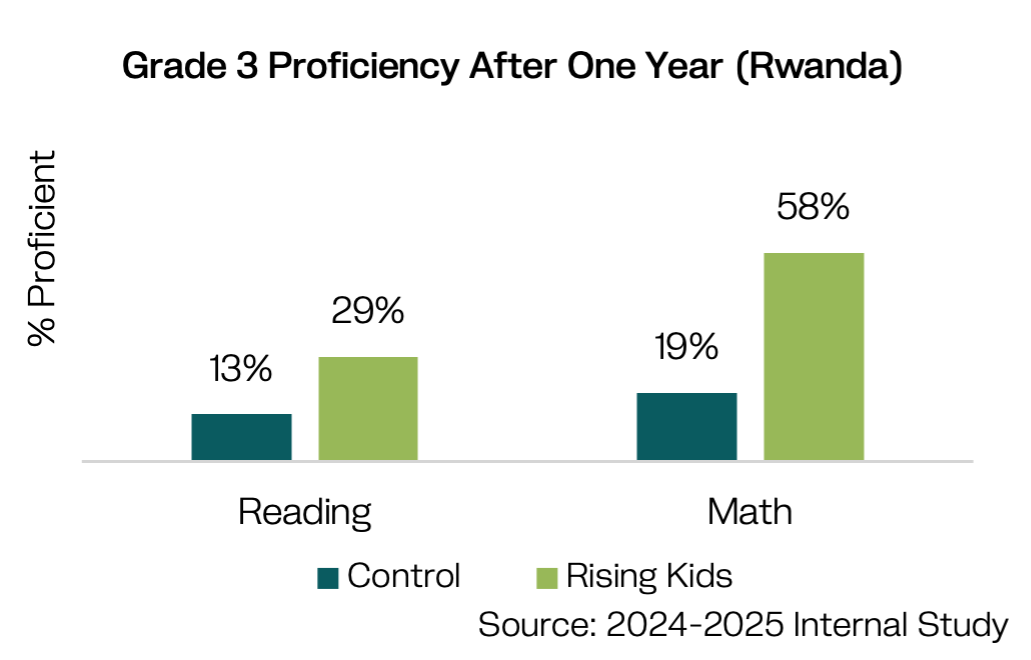
This is about impact and evidence. A 2025 internal EGRA/EGMA study in Rwanda showed that 29% of 3rd graders were on track in reading (vs. 13% control) and 58% in math (vs. 19% control). A more rigorous independent Randomized Control trial is planned. The Rwanda results build on Randomized Control Trials conducted in Sierra Leone (0.29-0.36 standard deviation gains), Liberia (0.40-0.55 SD gains), and on their math chatbot Rori (0.36 SD gains). These gains are relatively robust in the education sector.
This is about scope. 90% of children in Sub-Saharan Africa do not have basic literacy and numeracy skills. Schools are often overcrowded with underqualified teachers and insufficient instructional materials. Rising’s scalable model has the longest track record in Sierra Leone and is accelerating in Rwanda, where there is existing public infrastructure that makes this possible (teacher/coaching workforce, training systems, tech viability). We don’t yet know if there are enough paying government customers and profitable businesses to serve this low-income market beyond Rwanda.
This is about whether businesses can deliver the model. There are other for-profit education providers in the broader marketplace, but they don’t often serve this low-income segment. The integrated solution of content, training, and tech systems should be simple enough for governments customers to deploy across public schools nationwide. Despite the rigorous evidence of impact, we don’t yet know how involved Rising needs to be for long-term implementation fidelity.
This is about what the model costs if delivered by businesses and whether customers are willing and able to pay. The target price is $5/student/year for governments paying for the light-touch RisingFaster model against a current price of $11/student/year. Co-financing has begun in Rwanda with the City of Kigali paying 50% of marginal costs. Philanthropy is still paying for the majority of recurring costs.
.png)
Rising is at mid-growth.
Our Take
Rising continue to show that kids across contexts are learning exceptionally well. What they still want to prove is how well they do with limited Rising supports and implementation fidelity when governments run it long-term. The big question is the market. We know there are a bunch of for-profit and nonprofit providers in the space, but few that have an evidence-based model that governments are paying for at scale. Rising is seriously testing this in Rwanda, and we’re excited to see if this can spur other government customers.
Are you a serious funder and want to learn more?
This is just a snapshot of what we know about the organization. If you're an investor or funder that might send some serious dough their way, we're always delighted to share more. Reach out and we'll connect you with the right person on our team.
*this is not monitored for funding requests.
.jpeg)