Sustainable Finance Coalition (SFC)
It takes a lot of money to restore and protect nature. There isn't nearly enough of it.
The Idea
A Nature Finance Lab
Fellow

Candice Stevens
Mulago Lead
s


.jpeg)

Total Investment
1000000
Grants
0
Equity/SAFE
0
Debt/Convertible Debt
Funded Since
2022
Geography
Sector
Structure
The Mission
Thriving African landscapes.
How It Works
Sustainable Finance Coalition (SFC) developed an inventory of finance solutions that can work across many contexts. Their superpower is ferreting out clever ways to use things like tax codes and bond structures to unlock capital. They work with conservation organizations and financial institutions to find the right finance solution for the right landscape and help them customize it to get new money flowing to landscapes at scale.
The Dream
Organizations all over Africa use SFC’s tools to power landscape conservation.
Why We're In
There’s a huge need for reliable, long-term financing in conservation, and SFC’s inventory of solutions can be tailored across diverse landscapes. They have a knack for using common financial tools in novel ways to fit specific landscapes. It's early, but they're steadily building their inventory of tools that have already unlocked an additional $43M to benefit 69K hectares. We’re particularly excited by their work with other Mulago conservation organizations.
Impact
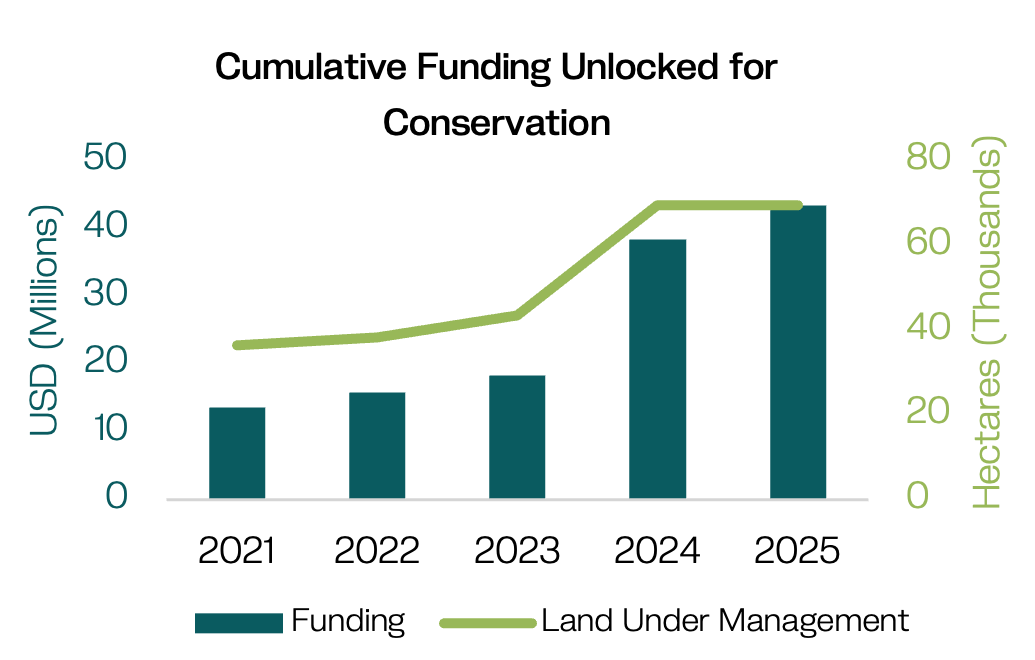
SFC’s model has launched 4 finance solutions that have helped unlock $43M in additional finance (cumulatively) to effectively manage 69K ha of land.
The Model
A solution that works and can scale.
Inventory of finance solutions
Suite of finance solutions that can be tailored to different context.
Tailored solutions
Assess finance needs of a landscape, develop the right solution for that context with input from experts, test the solution at small scale, and then apply the solution across the entire landscape and beyond.
Network of experts
Group of cross-sectoral experts to tap into when developing and scaling solution.
Potential for Impact at Scale
Mulago uses four criteria to gauge potential for exponential impact. The model must be:
This is about impact and evidence. So far, SFC has helped unlock $43M for conservation for effective management of 69K hectares, cumulatively. They cannot yet translate how the capital they unlock leads to measurable conservation outcomes. However, they design solutions rigorously, working only in landscapes where conservation organizations meet the highest standards of effective management . Their model focuses on securing long-term finance that cannot easily be reversed while embedding safeguards to prevent misuse of funds.
This is about scope. There is a global conservation finance gap of roughly $900B per year, and much of the funding that exists fails to reach the places and communities that need it most. Conservation funding comes from five main sources: official development assistance, philanthropy, tourism, positive incentives and subsidy reform, and sustainable finance solutions such as bonds, trusts, and debt-for-nature swaps. Today, sustainable finance makes up about 12% of total conservation funding, but SFC believes this could grow to 25–35%. For this to work, strong management plans must already exist, and developing solutions requires specialized expertise and networks, which could constrain scale despite strong demand.
This is about whether conservation NGOs and financial institutions can deliver the model. Unlocking sustainable finance is typically complex, technical, and slow, moving from concept to implementation over years. So far, SFC has scaled four finance solutions in six years, three of which are tax-related solutions launched in South Africa. Replicating SFC’s technical expertise is not straightforward. To address this, they are testing ways for partners to adopt their approach, including step-by-step materials, open-source guides, and one-pagers explaining their solutions inventory. They have also embedded staff within NGO and financial institution partners to transfer skills. Jury is still out if others can replicate this successfully.
This is about what the model costs if delivered by NGOs and financial institutions. Their current cost estimate is it costs SFC ~US $55K/year to develop a finance solution (mostly staff and expert time), and a solution takes 1-3 years to launch. They believe they are already at the target cost because SFC runs a lean operation with a fast, efficient timeframe for launching solutions. It could cost other organziations more or less to design a solution depending on how many resources they need when they design solutions and how long it takes them to do it. We don’t know yet.
.png)
SFC is in early Growth stage, deepening their understanding of impact, launching and scaling more solutions, and exploring ways to replicate the model via other NGOs and financial institutions.
Our Take
There is a large need for reliable, long-term conservation financing across Africa, and SFC is showing that its inventory of solutions can be adapted across diverse landscapes. Their approach applies common financial tools—such as bonds or tax incentives—to conservation contexts. SFC focuses on landscapes with strong management plans but insufficient funding. While attribution to conservation outcomes is indirect, their methodology includes rigorous design and safeguards, such as South Africa’s 37D tax incentive tied to verified stewardship standards. The biggest constraint to scale is SFC’s own expertise and network, though efforts to systematize and teach their process are encouraging as they test replication with NGOs and financial institutions.
Are you a serious funder and want to learn more?
This is just a snapshot of what we know about the organization. If you're an investor or funder that might send some serious dough their way, we're always delighted to share more. Reach out and we'll connect you with the right person on our team.
*this is not monitored for funding requests.